
Your conference rooms’ A/V does not have to be complicated.
You should not have to “Call IT!!” to come fix your conference room’s A/V system. Ever.
So why do we hear over and over and over the following mantra: “Yeah, can y’all come have a look at our conference rooms? Nothing ever works. Completely unreliable.”?
Well, it’s the answer is not complicated, but the setup of these conf rooms is. It’s overly complicated.
It doesn’t have to be. Here’s why most conference room A/V systems create nothing but pain for their users.
You flew to close to the sun.
OK, I jest, but it’s true. Here’s some of the things we’ve seen in just the last 6 months of evaluating, and ripping & replacing a bunch of conf room A/V systems.
* “We can watch the SuperBowl here!” You can, but you don’t need a direct CableTV hookup through the floor core for 1 day a year.
* “We have to be able to handle any type of connection!” No, you don’t. Look to the bell curve! Capture the 80%. The edge cases are edge cases for a reason.
* “It’s gotta have an HDMI cable hookup!” No, it doesn’t. How many of your company’s new laptops have an HDMI port? How many have USB-C? USB-C is ubiquitous.
* “It’s gotta have built in surround sound!” OK boomer, your Dad’s house in 1981 had “surround sound”, but he also had a “Hi Fi Stereo System”, didn’t he? And how are all those wires and built in speakers looking now? They’re decaying. In the walls. It costs a LOT of money to permanently install speakers in your ceiling, and more to rip them out 3 years later because they don’t work.
* “A speakerphone on the table is a must.” It’s actually not, and that’s one more cable you don’t really need.
Those are the most celebrated “must haves” for conference room A/V.
The new truth is that, thanks to 2020 and covid, not only did remote work get an upgrade, but conference room A/V did, too.
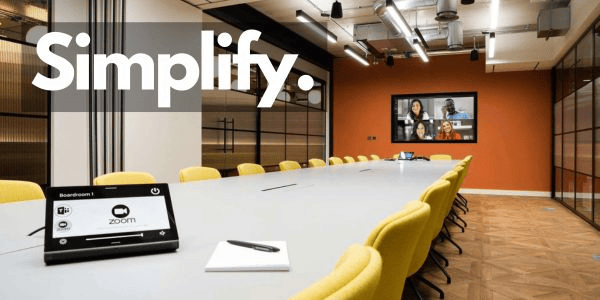
Here’s what most mid-sized conference rooms need:
– 1 large TV screen/monitor (75″-85″) on the wall
– 1 Logitech Rally Bar (camera & speakers) below the screen
– 1 Logitech Tap IP controller on the table
That’s it. One (1) cable to/through your conference table.
It doesn’t have to be a Logitech. There’s Nureva, Neat, Barco, and others.
How do you decide? Are you a Microsoft shop or a Google shop? Microsoft Teams will point you in one direction. Google Meet another.
Prefer Zoom meetings? OK, Logitech has you covered.
If you’re a Microsoft shop, Teams will likely be your default, and from there, your 80% is covered. The “edge cases” can be taken care of by inviting “the conference room” to the Zoom or Google meeting.
And that’s the biggest improvement: the Conference Room is now an invitee & attendee at your meetings. Wanna have a meeting in “Room A”? Invite the room to the meeting. Inviting the room reserves the room on the calendar.
Share your screen? Create & join a Teams, Zoom, or Google meeting. Simple.
Now that we’re embracing hybrid WFH/RTO, conference rooms are used more than ever. Keep them simple.
Simplify Your A/V
Comments
More from Kevin
-
6 Best Practices for Social Media Marketing Newbies
This post originally published on the General Assembly Digital Marketing Blog. You’re just starting out actually marketing a business or non-profit organization using various social media channels and tools. You’re not a social media marketing expert yet, but you will be very soon. What’s your next step? It’s wise to start off with some boundaries…
-
Digital Marketing 101: Social and Search Paid Advertising
This post originally appeared on the General Assembly Digital Marketing Blog. This post is the fifth in a series of six posts we’re calling “Digital Marketing 101,” in which we have broken up the General Assembly Digital Marketing class into six bite-sized chunks for those who are considering entering the digital marketing space, or who…
-
Digital Marketing 101: Owned Content Marketing
This post originally appeared on the General Assembly Digital Marketing Blog. In the first three parts of this DGM 101 series, we established that your marketing must start with your brand, and your brand is “everything you do.” Then you set up your web property and marketing plans so that you can measure everything…
-
Digital Marketing 101: Measuring Your Digital Marketing Efforts
This post originally appeared on the General Assembly Digital Marketing Blog. “You can manage only what you measure.” There are many different versions of that mantra, and all of them hold true. Just as in fitness and weight loss, if you don’t start with a baseline, take regular measurements, and see what’s working, you can’t…
-
Old marketing vs. new marketing: the only difference is data
I love finding old ads for products we used to own in our childhood or teen years, like this 1983 Jeep Grand Wagoneer. Classic! I also am a huge fan of the series “Mad Men”, which is the essence of old school marketing, better known as advertising. Back then, it was similar to the old…
-
It’s not you. It’s me.
I led an all day seminar this past Saturday at General Assembly in Atlanta. This class was a 6-hour event in which we compressed the 60 hours of the GA Digital Marketing class down to 6 hours, lunch from Chipotle included. Here’s a good description of the class and here’s a follow up to the…
-
3 things that make it hard to tell your story
It is my business to help entrepreneurs and small businesses tell their stories. Telling your story with great, compelling, consistent content builds trust among your audience, and helps them know that you have a solution to the problems they face every day. Most entrepreneurs don’t think they can tell their story, and they also don’t think…
-
Why to Tell Your Story
I’ve written recently about telling your story and how to keep telling your story ad how some stories write themselves, but haven’t really delved into some deeper reasons to tell your story, so here’s the “why” of telling your story, both your personal story and the story of your business. I spent the day today on…
-
The Seven Things You Must Do to Win at SEO
This post originally appeared on the General Assembly blog. Most non-developers are completely ignorant of, if not intimidated by SEO. Even some software developers won’t go near it. SEO has been called “black magic,” “dark art”and “pseudoscience,” most likely because if you happen to get it right, you win all the Googles! And everybody wants…

Leave a comment