Author: Kevin Sandlin

  • Wanna Stay Young?

    Do Hard Things.

    When I was young, I wanted a life of comfort. I worked hard so I could relax, do nothing, and be comfortable. Somewhere along the line, that changed to wanting to be UNcomfortable.

    My great Aunt Romie died at 96. My wife’s great Aunt Miriam died at 103. Both had the same philosophy about living longer:

    Never stop; never sit down.

    They took away Miriam’s driver’s license when she was 99. She kept her car, and never had an accident.

    Now I embrace doing hard things.

    Earlier, I shared about how we knew going into the first weekend of Georgia State Defense Force Search & Rescue (SAR) training, we had to have 61 gear items, all in working order, stored in our pack so we could get to it.

    Last weekend for the 2nd of 6 SAR training weekends, I joined 14 of my fellow state guard soldiers in the north Georgia mountains.

    The focus of the weekend’s training was land navigation. Our focus was staying warm.

    I can now say I’ve slept in a tent in 20°F weather. Not on my bucket list.

    As we were complaining about that, between chattering teeth, someone reminded us that we woke up on Saturday, Dec 7, Pearl Harbor Remembrance Day. Then she said, “How cold was it in Bastogne?”

    Oof. No more griping. We had proper gear, tents, access to a fireplace. I had a fresh cup of coffee.

    Shut up, SSG Sandlin! Hooah.

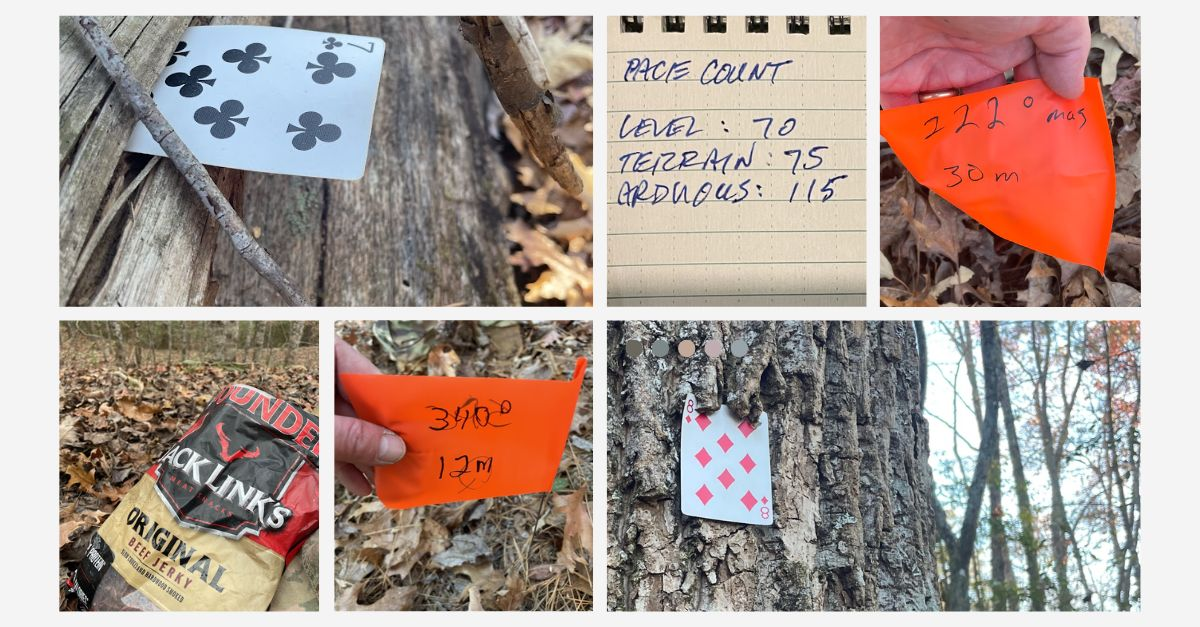
    So, once again we chose to embrace the suck. Put on our gear, and get moving to first formation, PT, and into the woods to find those cards. In the picture, you’ll see a couple of playing cards hidden (ok, “placed”) at certain 8-digit coordinates by the Cadre. Our assignment was to use our maps, compasses, protractors, and knowledge to find these cards somewhere in a few hundred acres of woods.

    We were randomly divided into teams of three. That was the second challenge. Who’s good at navigation, pace count, radio, scribe, decision making? You need all of these to find the objective.

    The advice that was handed down was this: “do what you suck at.” In other words, if you are totally lacking confidence in your ability to properly communicate via shortwave radio, pick up the radio and use it.

    Do what is hard for YOU. If you suck at keeping a pace count and communicating distance, volunteer to do the pace count. And if you suck at reading a map, pick up the map, compass, and protractor and get on it.

    Do what is hard for YOU.

    Our teammates have just as many weaknesses. THAT’S why we’re IN class, and not teaching it (yet).

    Our team found 2 cards. The “winning” team found 4. They earned the comfort of getting to sleep all night, rather than getting up and doing their hour of fire watch over the camp.

    They earned it.

    The rest of us did the other hard thing of getting up at 3AM in the 20°F dark, walking the parking lot and tending the fire, and then trying to go back to sleep at 4AM knowing we had to get up in 2 hours.

    After this weekend, I *know* I can do it.

    That made my Monday AM presentation all that much easier.
  • WFH for Govt?

    WFH applied to govt workers as well because of hashtag#covid. Our Federal (and local & state) governments own massive amounts of CRE. We have recently learned that fewer than 10% (it’s more like 1-2%) of civil servants report to an office.

    That’s great for them, right? Yeah, good for them if they can get the job done from home. But that means that billions of taxpayer dollars are being wasted on empty buildings.

    And, if you think it’s a challenge to maintain culture and accountability with WFH employees in the private sector, you can multiply that many times over for govt employees.

    So, no, govt services have not improved with WFH. In fact, most would agree they’ve gotten worse.

    Patrick’s point #3 is easy: govt produces nothing, so it cannot and will not produce anything meaningful with WFH. Govt exists (ahem, “should exist”) to serve the taxpayers.

    It is now, thanks to the 2024 election and the newly created Department of Govt Efficiency, being elevated to the forefront that our Federal Government is actively wasting TRILLIONS of dollars, and a huge chunk of that is on empty CRE facilities.

  • New Grads: WFH or RTO?

    My daughter just got her first “big girl job” (her words), and the job is a hybrid position. Her new employer has a plan for how to engage brand new college grads as hybrid or remote employees.

    * She is spending 2 weeks on site in training, learning the job and the systems, tools, and processes necessary to do the job.
    * They shipped her equipment (computer, monitors, docking station, keyboard, mouse) the week before her training.
    * They planned her training around their quarterly town hall meeting to meet her co-workers and get a feel for the culture.
    * Part of her training is actually WFH, so she can DO the job using the equipment they provided, making sure everything works while she’s still “in training”.
    * The training is with her immediate supervisor, in person, so they can get to know one another.

    I’m sure they didn’t get it perfect the first time they tried it, but they created a plan, so that after the first few hybrid/remote employees got started they could review the plan and see what worked and what didn’t.

    In the military, they call this an “AAR”, or After Action Report. Every AAR is different, but in general, leadership asks for three things that went right and we want to repeat and three things that went wrong that we have to fix. That’s a guideline, sometimes there are 13 things that sucked.

    The AAR or any type of post-mortem on any project is MUCH easier when you’ve been through a rigorous planning exercise.

    Why? Because you have THOUGHT through what you THINK will happen. In the AAR, you get to look at what ACTUALLY happened compared to your plan.

    That’s where you actually see where you were right and where you were wrong.

    As Patrick noted, hybrid isn’t going anywhere, so all employers need to plan for it. Part of that planning process is making sure the tech is in place so your hybrid employees can have a great experience when they work from home AND when they work from the office.

    What’s your plan?

  • What are you thankful for today?


    Me:
    – My God & creator, who has blessed me with this life and all its ups and downs to get me to exactly where I am today
    – My Proverbs 31 wife of 31+ years, who works part-time and runs her own custom cookie business (https://lnkd.in/ejWS3SGE)
    – My special needs son, who is excelling in his job, making his own money, and maturing
    – My daughter, who graduated college, got engaged, and just got her first “big girl” job
    – My future son-in-law, who worships the ground my daughter walks on, has more guns than me, and can fix anything
    – My job, which is not as *sexy* as owning the largest indoor shooting range in Atlanta, but enables me to use my gifts and work with a great and talented small team
    – My GSDF brothers, who hold me accountable, run me ragged, and make me a better leader every day
    – My dog, Briscoe, who thinks I am much better than I really am
    – America’s military, who stand up and say, “Not on my watch!” and put their lives on the line for our nation
    – America, the greatest national experiment in history!

    What are you thankful for TODAY?

  • “Be a life long learner”

    How many times have you heard that advice? Me, too. But how do you do that?

    I’m sure I’m not alone when I resist learning something because there’s no purpose in my learning it other than to learn it. I need to have a “why” behind learning something brand new.

    So, when I think I want to learn something new, here’s how I go about turning that decision into action.

    I sign up to TEACH that thing, whatever it is, wherever I can, to whoever wants or needs to learn it.

    The Georgia State Defense Force has provided a solid outlet for that need. Before I joined GSDF, I did not know land navigation, search & rescue, D&C (Drill & Ceremony), knot tying, rappelling, wilderness first aid, radio communications, or how to *properly* operate a chainsaw.

    Now I do.

    And once I learned those things, I volunteered to train other GSDF soldiers to do the same. Not every one of them, of course, but specific topics.

    In order to be a solid instructor, I was forced (by me) to learn each subject at a much deeper level.

    My first was land navigation.

    Before starting GSDF, I couldn’t read a map to save my life. I am hopelessly addicted to Google Maps. Juxtapose that with my wife, whom you could drop off in Fallujah with her eyes closed and she’d be home in a few hours. I get lost going to Marietta from Roswell.

    But the training I got in Land Navigation opened my eyes. Now I just “get it”, and I am forever thankful to my instructors who learned it well enough to make me think it was easy.

    So they know it, and then I learned it, and now I know it well enough to teach it.

    Want to learn anything really, really well? Prepare to teach it.

  • Search + Rescue

    This past weekend, I joined 21 of my fellow Georgia State Defense Force volunteer soldiers at Camp Merrill for Search And Rescue Specialist II (SARII) training.

    We slept in tents, enjoying the 36° nights and 70° sunny days in the north Georgia Mountains. We learned. We embraced the suck. We became friends, and leaned on one another to get through the first of six grueling weekends to earn our SAR Tab.

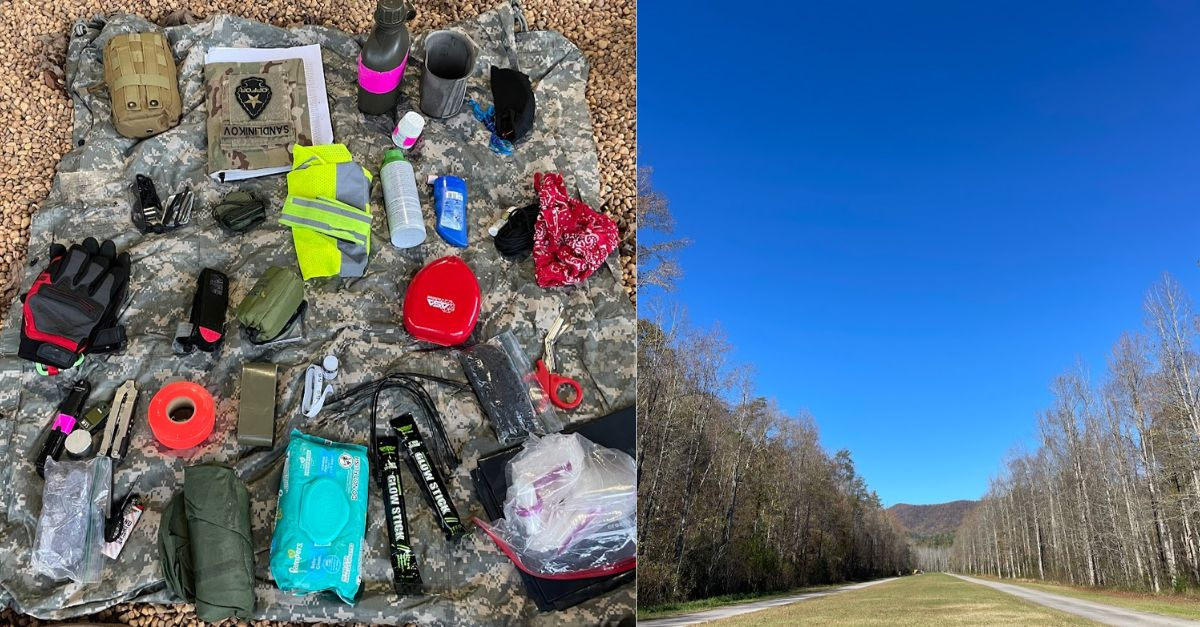
    In the attached image, on the left you see my “gear dump”, which consists of 61 specific items that have to go into our “SAR Kit” that we wear every minute of every day for the duration of training.

    So, we are taught that “ounces are pounds, and pounds are pain.” We learn that lesson first hand during the “work capacity test”, in which we must walk 2 miles in less than 30 minutes carrying a minimum of 30lbs in our pack.

    We’ve known since August that this has been coming. We’ve known since August that we have to have very specific items purchased, configured, packed, balanced, ready to use, and within hand’s reach, because you simply do not know what you will need or when you’ll need it.

    But everything has to work exactly when you need it. Knowing that, you make a plan, a list of your gear, where it is, how much of each item you need and have, and exactly how to get to it exactly when you need it.

    Sound familiar? That’s how it is when you’re building or moving into a new work facility, knowing without even thinking about it that you are 100% going to need:

    • To control who has access to the facility
    • To bring blindingly fast Wi-Fi to every square inch
    • To cover the important spots with 4k security cameras
    • To make your Zoom Rooms or Teams Rooms “CEO proof” (IYKYK)
    • To ensure sound privacy between offices and conference rooms

    Some of these, you and your coworkers will utilize every day without a second thought (Wi-Fi, card key access, sound masking). Other things, you get nervous about using because you’re not sure if you’re gonna do it right or if that big beautiful TV is going to show your long-awaited PowerPoint perfectly or not! Yay A/V!

    But you’ve known for months that you’ll need all of this low voltage service.

    Move-in day is coming. Are you prepared? Do you have an LV plan?

    If you do, then your “gear list” will enable you to enjoy your new facility like a beautiful autumn morning in the North Georgia Mountains.

  • Amazon Mandates RTO

    Yesterday, Amazon CEO Andy Jassy held a meeting to discuss the pending return to office mandate at Amazon. A summary of his defense of the mandate:

    “This was not a cost play for us. This is very much about our culture and strengthening our culture.”

    As expected, the response is coming in hot.

    Now go back 10 years, and consider this situation: you hire a new employee, and expect them to show up at work on their starting day.

    Weird that we now consider that as just one option.

    One hot take on the negative view of Jassy’s RTO mandate made these points on why Amazon will “risk losing talent”, citing a survey of 3,853 Americans conducted in February 2024:

    * Remote work boosts critical areas like mental health and engagement.
    * For most employees, full-time office work isn’t the ideal setup.
    * Only a small portion of workers actually perform better in an on-site environment.

    As I work from my screened porch this beautiful fall morning, I maintain my point of view that WFH vs. RTO is 100% dependent upon the organization, and senior leadership has the very visible responsibility of choosing the best path for their organization.

    I’m on Jassy’s side here: “This is very much about our culture and strengthening our culture.”

    The only thing in any business that leadership has 100% control over is the culture of the organization.

    You can build and maintain great culture with WFH, RTO, or hybrid. Any of them will work.

    Leaders get to (have to!) choose.

  • Customer Discovery vs. Focus Groups

    Image courtesy of boomtownboulder.com


    During the first night of the Digital Marketing (#DGM4) class at General Assembly Tuesday night, we went down a number of really great rabbit trails. I encourage such Q&A because it really adds to the class and enables us to apply learning to the students’ actual jobs today. One of those quick sessions resulted from a question after I had given a brief introduction to the concept of customer discovery.

    The student asked, “What’s the difference between customer discovery and a focus group?” Great question! Below is a list of some of the differences. There are some similarities such as getting responses from numerous potential customers and asking lots of questions, but the differences are more profound.

    • Customer discovery occurs prior to any product being built; a focus group tends to seek responses to some idea or stimuli from a group of prospects.
    • Customer discovery requires speaking to as many potential customers as possible; focus groups can be fairly conclusive with just a few groups, or maybe even one.
    • Customer discovery is about finding a problem in which to insert a product; focus groups typically have the objective of a group’s reaction to an existing product or idea.
    • Customer discovery requires the entrepreneur to ask questions whose answers will surprise or even shock; focus groups are seeking specific answers or responses.
    • Customer discovery is typically done one-on-one and one at a time; focus groups – by definition – are groups of people that may tend to feed off of one another.
    • Customer discovery may take months or longer; focus groups are usually time contained.

    This question was a great way to give the group a solid intro into startup world, and specifically into customer discovery. That discussion came on the heels of talking through the basics of digital marketing, which cannot even begin to start until the message is created. And the message starts with the problem you are solving (“Start with WHY”), and that problem is identified through customer discovery.

    Great start to DGM4! Can’t wait to see what the next 10 weeks bring.

  • DGM4 Starts Tuesday at General Assembly

    If by now you have not made your way down to spend some time at General Assembly at Ponce City Market, you’re pretty much doing it wrong. GA is a great global brand in the digital training space, and they’ve built up a first class operation in Atlanta’s Old Fourth Ward.

    Tomorrow night at 6:30pm, twenty eight (not a typo, but a ridiculously successful class of 28!) new digital marketers will begin their journey towards Demo Night on October 22, at which they will each present their 5-minute pitch of their digital marketing strategy. Each student is required to submit a real project for which to build a DGM strategy. That project can be their own personal blog, their company, or, in this case, a nonprofit that needs some assistance.

    This class will be taking on a number of nonprofits curated by GA for just this purpose, giving the students a real time view into a real digital marketing need and giving the nonprofits the help they need attracting their target audiences. In addition, the class members will have the option of preparing for the Google Analytics Certification, something that is a much needed skill and base of knowledge in the digital marketing space.

    This will be the second time I’ve taught this class. Last spring, we endured the transition from GA’s temporary space next to Dancing Goats into their sweet new 2nd floor campus in Ponce City Market. I enjoyed teaching most of the sessions last spring, but I’ll be making some cool new changes this time around to make the class even more hands on, and give the students more time to interact and share ideas and learning.

    Finally, we’ll be serving up some of the best marketers in Atlanta as guest speakers. We have room for 2 more, so if you are a digital marketing rock star and have a strong desire to share your knowledge with the next generation of digital marketers, I’d love to hear from you. Pick your favorite topic that coincides with any subject on the DGM Syllabus, and we’ll make it happen.

    Here we go, DGM4!

  • Content + Images = Dope

    Good content is nothing without good images.

    It’s like PB&J. Or a bagel and schmear. Or popcorn and butter.

    My love affair with food aside, content and high-quality complementary photos and graphics are the perfect match.

    The Lowdown

    There’s a reason you can’t have content without an image.

    It’s the world we live in now: Thanks to the Interwebs, we can now all changed our learning style to “visual.”

    Think about how you read news or stories online: You scan it for the juicy tidbits.

    In fact, a lot of popular blogs “write” articles by simply posting a row of Twitter status updates from clever/disgusting/anger-inducing users (usually celebrities, amiright).

    Your content is probably much more interesting – and helpful – than that.

    But if you want to get eyeballs on it, you’ve got to get visual with it.

    Social media sites almost exclusively cater to images, not words. Think about it: Facebook, Pinterest, Snapchat.

    Even sites that depend heavily on text such as Twitter and LinkedIn, good images prop up your content.

    Don’t Get Slap Happy

    You can’t just find a stock photo, stick it at the top of your content, and call it a day.

    You’re better than that. And even if you’re not, your content deserves more.

    After all, it’s going to be living on your website for-pretty-much-ever. People are (hopefully) going to link to it from other places.

    Content + any old image = mediocre. Content + the best image = jaw-dropping.

    There’s a bunch of free stock photo sites out there. If you don’t know them, Google will point you in the right direction.

    Don’t use the first stock photo you see. And please don’t use the stock photos your competitors are using.

    And please don’t use those stock photos of peoples’ stretched heads screaming or making odd faces. Those have made an appearance in my Feedly way too often lately.

    My suggestion? Find a stock photo that makes sense when paired with your content. Your readers’ subconscious will say, “Ah-ha!”

    You could even pay for it. Gasp, I know: Marketers and their meager budgets are almost never parted. But it’s almost always worth the quality and uniqueness.

    Before You Hit Go

    Don’t hit that alluring publish button yet. There are still some items to check off your list:

    Add a filter: Guess why Instagram is the popular kid? Because of those filters, baby.

    Add text: Go ahead, put the title of your post or a subtitle overtop of your image. Post it underneath your title. Share it on social media. Watch your engagement rate skyrocket.

    Experiment with fonts: Apps such as Canva and WordSwag are free and have a bevy of amazing fonts to play with. Release your inner graphic designer! And if you’re not sure where to start, imitation is the sincerest form of flattery. Pull a Steve Jobs: Copy the designs, layouts, and fonts of your favorite brands, but make them better.

    Add your logo: Remember, your content and this image will live forever. Anytime it’s shared or seen, don’t you want your brand there, too?

    Size it correctly. YA’LL. Please stop posting images on Twitter where the person’s head is cut off. Or your image text is cut off on the righthand side. Or your Pinterest graphic is fuzzy. There’s too much technology availble today to have any excuses for not sizing images appropriately for each channel.

    And they all lived happily ever after

    In just a few words I’ve convinced you content and images can’t be parted. At least I’ve tried.

    But sometimes even when we know something is true – like the fact that ice cream and beer isn’t a healthy dinner – we don’t change our ways. It’s just so…uncomfortable.

    It’s hard to kick old, easy habits. I’ll admit it – sometimes it’s no fun to work hard picking out an image and figuring out what fonts are going to work.

    But I promise, it will be worth it.

    Just try it once. Write your next blog post and create that eye-catching image. And tell me how it goes.