Category: Digital & Content Marketing

Our blog on content marketing and digital marketing

  • Digital Marketing 101: Social and Search Paid Advertising

    This post originally appeared on the General Assembly Digital Marketing Blog.

    Intro-to-mobile-advertising

    This post is the fifth in a series of six posts we’re calling “Digital Marketing 101,” in which we have broken up the General Assembly Digital Marketing class into six bite-sized chunks for those who are considering entering the digital marketing space, or who need a primer on the basic building blocks of digital marketing. The first four posts covered:

    1. Developing a Brand Strategy
    2. Measuring & Metrics
    3. The Digital Marketing Funnel
    4. Owned Content Marketing

    Up to this point, if you were building a new business or a digital strategy for an existing business, you’ve determined your brand strategy, voice, and keywords, written down your Key Performance Indicators (KPIs), have a solid grasp of the marketing reach you need to achieve to hit your revenue (or lead) goals, and you have a clear strategy for creating and publishing marketing content.

    But you still haven’t spent any money on marketing. For many small businesses and startups, you might skip this 5th step if you simply don’t have the budget to pay for search and social marketing reach. However, if you have any budget at all, even just $25 or $50 of $100 per month, the reach you can achieve by targeting your audience on search and social has never been more cost efficient.

    Here are the 5 questions you must answer before you engage in spending money on search and social advertising:

    1. Budget – how much money can you spend each month? Spending a lump sum once is useless.
    2. Goals – what specifically do you want to accomplish with your ad?
    3. Audience(s) – who exactly are you trying to reach, and why?
    4. Message – what is the message you want your audience(s) to hear?
    5. Content – What types of content (text, image, video, or combination) will you show your audience(s)?

    Once you’ve answered the points above clearly, concisely, and consistent with your brand and strategy, you should be well on your way to deciding which of the following advertising channels will work best to reach your desired audience. No channel is one-size-fits-all, so you should understand the strengths and weakness of each channel, and what they are good for. The chart below will help you through that decision.

    channels

    Google, Facebook, and Twitter are usually regarded as the easiest to use because their processes for conducting an ad campaign are extremely simple. Google owns 98% of the search advertising traffic, so if you learn to use the Google Keyword Planning Tool in Adwords, you are almost guaranteed to get traffic, but you must remember that every click costs you money.

    Facebook has 1.4 billion users, so the reach is fantastic (since you’re paying for it), and because Facebook knows everything there is to know about most of their users, the ability to hyper-target your audience is very powerful.

    Twitter’s user base is much smaller than Facebook’s, but stronger in many market segments such as technology. Twitter’s campaign planner is very simple, and like Facebook’s, the first step asks you what you’re trying to accomplish.

    Facebook Ad Campaign Twitter Ad Campaign
    FBcamp twittercamp

    The key to any digital advertising campaign is test and measure, test and measure, test and measure until you determine the ad types, channels, message, and audience that get you the best results. What’s very advantageous about any digital ad campaign is that you can conduct a campaign for one day, one week, one month, or any custom length of time, then measure the results.

    Explore Digital Marketing At GA

  • Digital Marketing 101: Owned Content Marketing

    This post originally appeared on the General Assembly Digital Marketing Blog.


    Blogging-for-Business-How-to-Extract-Value

    In the first three parts of this DGM 101 series, we established that your marketing must start with your brand, and your brand is “everything you do.” Then you set up your web property and marketing plans so that you can measure everything and keep a close eye on your KPIs while you determine your budgetary needs by doing the math to get through the marketing funnel.

    When you start your marketing strategy execution, the first place to start is by executing on the part of the marketing plan that requires no ad spend: owned content. To be clear from the start, we first need to have a firm understanding of what exactly is included in “owned content:”

      • Web copy – the words you use on your website(s) should match up and complement the words you use to describe your brand, so your audience consumes a consistent message regardless of the medium or device on which they receive your content.
      • All images – the images you curate or create for use on your website, in any social share, and in marketing emails should reflect your brand, your message, and your audience.
      • Blogging – the most dynamic content on your website is your blog, which tells your audience the story of your brand day by day as it unfolds. This content is where prospects and customers alike will go to learn from you, learn to trust you, and ultimately learn what your brand is all about. This content is your most influential content. Use it to set your brand apart as an authority in your market space.
      • Social sharing – sharing on Facebook, Twitter, Instagram, Linkedin, or any other social channel is more than just sharing. Every word you write and every image you share is content, and each should reflect your brand, and offer value to your audience.
    • Email marketing:
      • Email newsletter – a regular, consistent email newsletter to an opt-in audience has the power to drive your business. This audience has given you permission to contact them regularly for the purpose of teaching them, influencing them, and telling them what you have to offer. Every word and image in each of these emails is critical.
      • Transactional email – anytime someone places an order or signs up for something (like an email newsletter) from your website, they should receive an automated email. This transactional email is a powerful opportunity for you to connect with that customer or lead in an email that they will expect as confirmation of their transaction.
      • Behavioral email – When someone performs – or does not perform – a certain action on your website, tools like Pardot and customer.io give you the ability to reach out to that prospect and connect again to reward their action or, if they left a shopping cart abandoned, spur them to action with an offer.
      • Individual email – Many businesses, small and large, omit individual employees’ email from their branding and marketing. How many emails do you send every day to customers and prospects? You should insert your brand and a call to action in your email signature. That, too, is owned content.

    Everything you produce and publish to your digital audience is considered “owned content” because, by definition, you created it, publish it, and own it. Owned content can be just as valuable as paid ads. One simple and powerful example is Arby’s tweet to Pharrell during the 2014 Academy Awards program, which continues to add to its 78,000 retweets to this day.
    ownedcontnet1


    That Oscars moment is one in a trillion, so the more reliable plan will be to create and maintain an owned content calendar for every week, month, and year in your marketing plan, and abide by that plan. It takes lots of time, hard work, and collaboration to create such a calendar, but ultimately, creating and publishing your own content is the most efficient way to market to your target audience without spending any hard cash.

    ownedcontent2


    Finally, all the owned content you create, especially on your website and now on Twitter, has one very powerful benefit: SEO. Search engine optimization is what gets your site to the top of the Google results page when a prospective customer or user searches using keywords that you use every day in your owned content, because those are the words that describe your brand and the value you offer to your customers. Google loves fresh, consistently and regularly updated content on your website, blog, and now in your Twitter feed.

    In your owned content, all of your words and your images matter, so plan them and execute them carefully, frequently, and consistently.ore Digital Marketing At GA

  • Digital Marketing 101: Measuring Your Digital Marketing Efforts

    This post originally appeared on the General Assembly Digital Marketing Blog.

    Intro-To-Ecommerce-Successful-Strategies-for-Digital-Marketing

    “You can manage only what you measure.” There are many different versions of that mantra, and all of them hold true. Just as in fitness and weight loss, if you don’t start with a baseline, take regular measurements, and see what’s working, you can’t make data-driven decisions.

    In this second post of six in the series “Digital Marketing 101,” we’re offering up highly practical tasks for you to determine how best to grow your digital presence using data backed by marketing analytics.

    Getting Started

    The center point of everything is a high-quality web analytics tool like Google Analytics. There are other tools out there like KISSMetrics, but Google Analytics is free (Google wants you to know how well you’re doing!) and easy to setup and connect to your web property.

    Knowing that you can only manage what you measure, your first mindset should be to measure everything. You’re not going to report on everything, but your entire web property or mobile app should be connected to your analytics package from day one, and you should have a long list of metrics that you think you may need to keep a close eye on now or at some point in the future.

    Establishing Metrics

    From the “everything” pile, your Key Performance Indicators (KPIs) should be your top 3-5 metrics that you will probably look at every day, or at the very least once a week. For an ecommerce site, these metrics may, and probably should, include the following:

    • Page views (how many products visitors viewed)
    • Click Through Rate (CTR from various ads)
    • Conversion rate (orders / visitors)
    • Average order amount (are they buying one widget or several?)

    For a media site, your KPIs will be different, and include things like:

    • Pages per visit (how many articles did they read?)
    • Time on site (how long did they browse and read on the site?)
    • Conversion rate (email subscribers / visitors)

    Keep in mind that, especially if you’re starting from ground zero, your KPIs will change over time. For example, your measurement of “New Visitors” will change, because in the first month, almost ALL your visitors will be new. After you ramp up (ramp up time depends on how well you market the site and the total size of your audience), you’ll set a monthly average goal for how many new visitors you want to bring to your website. Also, once you know your baseline average order amount, you’ll want to set a goal to increase that average each month because that means an increase in revenue.

    How will you measure and mind all these numbers? Google Analytics. Once you’re set up, this fantastic tool will have all the data you need; however, you owe it to yourself as a digital marketer to immerse yourself in learning Google Analytics. The Google Analytics team has set up, and continues to add to and maintain, a huge and robust library of videos on the Google Analytics YouTube channel. You should bookmark this channel and commit to learning the tool inside and out as you grow your digital marketing expertise, because, as we’ve already mentioned several times, you can manage only what you measure, and if you don’t know how to measure it, you’ll never be able to change it.

    Finding Insights and Taking Action

    Once you’ve set your digital site in motion, you’re going to want to change it to make it better. Another adage that is at the heart of all web software is this: all software is 85% complete. Always. That means it’s never, ever “done.” You will eventually get from v1 to v40, like Google Chrome has done in just 10 short years, but your software is never done. But how do you know what to change next?

    You measure everything. In Digital Marketing, we teach the “OODA” loop. OODA stands for Observe. Orient. Decide. Act. That’s how you measure your digital marketing efforts.

    • Observe – this word is another word for “measure”, and you accomplish this task in Google Analytics. All your data is in your analytics tools. Make them a part of your daily life.
    • Orient – what ‘orient’ means in Digital Marketing is to determine what happened. Why did you get so many visitors at 3pm last Tuesday? Why did your email subscribe rate drop? Why did you sell 3X as many widgets this week as last?
    • Decide – what are you going to do next? Change the email signup process. Reduce the steps in the checkout process from six to two. Add beautiful images to your blog posts. But make these decisions based on data, not whether you like it or not.
    • Act – implement what you’ve decided based on the data that you collected by creating and measuring a new experiment.

    In digital marketing, it’s easier than ever to make data-driven decisions and support them with data. It’s also easier than ever to make changes to any website, and measure the effect of the changes instantly through an online analytics tool. And the OODA loop is the process by which we as digital marketers determine what works, what doesn’t, what to do next, and when to change it. We make decisions based on data because we have that data at our fingertips, because we have immersed ourselves in Google Analytics.

    Explore Digital Marketing At GA

  • Old marketing vs. new marketing: the only difference is data

    I love finding old ads for products we used to own in our childhood or teen years, like this 1983 Jeep Grand Wagoneer. Classic! I also am a huge fan of the series “Mad Men”, which is the essence of old school marketing, better known as advertising. Back then, it was similar to the old waterfall method of developing software, in which you do all the planning up front, freeze the specs, and build for months and months until launch. They used to buy magazine and newspaper ads months in advance, and then measure the results in the quarters that follow. They used data, but very much after the fact.
    Today, the basic operation is the same, but the game is so much faster. Digital marketing enables the marketer to conduct tiny, inexpensive (if not free) experiments to find the best avenues to gain market share, and then stomp on the gas when they discover what works the best. And then keep on experimenting. It’s really amazing to those of us who have experienced it both ways. The game is still the same, but it’s played at digital speed, rather than print speed.
    We rely on data vs. emotions. I think there’s a big misconception about the ads and campaigns they created in the Mad Men days. Yes, there was a lot of emotion involved (more in the show than real life), but the results were still measured in revenue, market share, traction, and growth. Back then, it took quarters and years see the results, and market share reports came in the mail.
    The numbers (still) never lie. Doesn’t matter really what you’re marketing or how you market it, if your strategy is wrong, the numbers will eventually reveal the fault. If your strategy is right and your tactics wrong, the numbers will tell the story. The difference is that, today, you can determine whether you’re on the right or wrong track in a day, not a year.
    The new marketing is still marketing. That’s my opening line for the General Assembly Digital Marketing class and bootcamp: “digital marketing is still marketing”. What I mean is the goals are still the same. We just don’t print a whole lot of anything anymore, but rather make sure it’s responsive and looks fantastic on a 4″ or 5″ screen. But we still aim to reach people who didn’t know about us before, and draw them into and then down the marketing funnel to become customers, and then engage and please them such that they become loyal advocates of our products.
    All the data is there now. Don Draper had data…after the fact. Results data was all that mattered. Today, we have instant data on every move our users and customers make on our web sites. We can even watch their mouse clicks and put a cookie on their device and retarget them when they leave our site. We couldn’t do that back in the day.
    I have fond memories of implementing marketing campaigns that utilized the sending of a grayscale fax to thousands of colleges and universities, and then coaching inside sales teams as they followed up, “did you get the fax we sent over yesterday?”
    Yesterday. Yesterday we had data to determine results, success or failure. Today we have data to see results in real time. Today we can take what was old, and make it look new.
    This is actually MY 1990 Grand Wagoneer, photoshopped into an AT&T ad in 2012. Amazing.
  • It’s not you. It’s me.

    I led an all day seminar this past Saturday at General Assembly in Atlanta. This class was a 6-hour event in which we compressed the 60 hours of the GA Digital Marketing class down to 6 hours, lunch from Chipotle included. Here’s a good description of the class and here’s a follow up to the last time we ran this class.

    This past Saturday had some challenges, and hats off to the folks at GA for pulling out all the stops when the Ponce City Market power went out on Friday night, leaving GA with no air conditioning all day Saturday. You heard that right. It reached 80 degrees in our classroom, but the many oscillating fans and ice cream sandwiches and popsicles made us feel loved anyway.

    And we used this problem to discuss the first aspect of digital marketing: branding. One of the most visible aspects of your brand is your message. What you say matters. Every word matters, because your brand is everything you do. The exercise we used to illustrate this point is outlined in this post on the General Assembly blog. It’s a good way to find out (a) if you know your brand and (b) how well you know your brand. We walk through this exercise because if you, as the founder or entrepreneur or brand ambassador don’t know your brand, how can you communicate that brand to anyone else, inside or outside the company?

    We start with – and for purposes of this post, we end with – the second part of this exercise: “what is the industry or market problem you are solving?” In creating this little exercise, the inspiration for this step is Simon Sinek’s 2009 TED Talk and his book, “Start with Why.

    The class did this exercise, taking about 15 minutes to create the 4 tweets. Where we ran into the most trouble was this step number 2. It is a trend that I have seen throughout my teaching experience at GA and for 2 years at Pitch Practice that entrepreneurs have great difficulty distinguishing the problem statement from the description of their business. In other words, when I ask “what problem are you solving?” the answer I get most often is “we do this and that, creating value here and there and saving our customers time and money with these benefits,” and then they proceed to list all the benefits.

    This answer is completely wrong, and it starts with the first word, “we”. The problem you are solving has absolutely nothing to do with “we” or “you” or “I” or “me”. The problem you are solving is a problem in the market that your customer has. When you are talking to a potential customer and that customer hears (ad nauseum) what you do, you’ve lost them. When you start with the problem that your customer has ever day (start with why), you make a friend. They now know that you see and understand their problem. Oh, and by the way, we solve that problem.

    This situation reminds me of this clip from Seinfeld:

    When you’re stating your problem, remember “it’s not you, it’s me”, and “me” is your customer. It’s all about the customer’s problem. Your problem statement has nothing to do with you. Rather, it’s why you exist. Start with why. Start with the problem, and solve it.

  • 3 things that make it hard to tell your story

    It is my business to help entrepreneurs and small businesses tell their stories. Telling your story with great, compelling, consistent content builds trust among your audience, and helps them know that you have a solution to the problems they face every day. Most entrepreneurs don’t think they can tell their story, and they also don’t think they have enough great content. Both are incorrect; however, there are several things that make it difficult for anyone, let alone an entrepreneur in the thick of building a business, to tell their story on a regular and consistent basis.

    Here are three things that can make it really tough to create great content on your own behalf in a way that is compelling and credible to your audience.

    • You’re too close to the product. You invented this thing, this solution to a market problem. You know it inside, out, and backwards. You can explain every feature, function, and bug. You know where it’ll be in 2 months and 2 years. But your customer can’t see any of that, and, for now anyway, doesn’t care. They want their problem solved right now, and you are not able to see the flaws that your customer sees instantly. It’s not a hit against the entrepreneur to be “too close to the product.” That’s your job! But it may mean that you can’t tell the story, explain the problem, or empathize with the customer objectively.
    • You are not your user. Just because it looks right to you and sounds right to you and seems right to you doesn’t mean that your user will like it, know how to use it, understand it, or even care. How can you share what you’re dreaming of from your perspective, when you really should be looking at the solution from your user’s perspective? It’s interesting to see how often an entrepreneur will fall in love with their own product. “I love this app!” they’ll say. But the app is not for you. It’s for your user. Do they love it? They might, but they might not, and the reasons they love it may be very different from your own.
    • You speak in your language, not the customer’s language. One of the funniest and most entertaining things in every small business and startup I’ve been in is the jargon, the language, the acronyms. At the telecom startup that was acquired by First Data, we once named a module “Ope”, which was really an acronym for “Order Processing Executive”, and yes, there was also an “Andy”, though I can’t remember what that stood for. Someone actually said these things in a meeting with a customer. After some very strange looks, we explained what it all meant. The customer got a good laugh, but couldn’t care less what we called our internal systems. They just wanted their information to get disseminated quickly and properly.
    While you really must tell your story, especially if you’re a startup or small business, it can be difficult, and these are some of the reasons why it can be hard. But that’s ok, because “you” doesn’t always have to be “you” personally. Your organization needs to create great content that tells your story as it unfolds and brings customers closer, and you can outsource that process or dedicate an internal resource to it.
    The vision should still come from the one who holds the vision, but the words do not have to be typed by you personally.
  • Why to Tell Your Story

    I’ve written recently about telling your story and how to keep telling your story ad how some stories write themselves, but haven’t really delved into some deeper reasons to tell your story, so here’s the “why” of telling your story, both your personal story and the story of your business.

    I spent the day today on the road with my family going to and from a funeral in Murfreesboro, TN. I have two teenagers, so part of the chatter on the way up was about why exactly we were driving 3 1/2 hours each way to go to the funeral of a lady we never met. It was an excellent teaching time, mainly to get through to a couple of teenagers that it’s not about them, but also that it was about our friend who’s mother passed away after 88 wonderful years of life.

    It was a wonderful home-going celebration of this lady’s life, and the theme that ran throughout all the words shared about this lady was “stories.” Sons, daughters, grandsons, granddaughters, and friends all spoke of the stories this lady would share about life, love, friends, family, history. Everyone who knew this lady knew everything about her life…

    Because she constantly told her story, both in writing and verbally.

    What’s this mean to you and me? Here’s 4 simple thoughts to answer that question, and I hope drive you a little closer to sharing your story.

    • All it takes is one generation who doesn’t know your story for your entire story to simply vanish forever. If you don’t regale your new employees with the genesis of your business, how will they ever know, understand, and live out the culture that you created?
    • How will they know how it all started? It’s said very often that you can’t know where you’re going until you know where you’ve been or where you came from. Or that you should always remember where you came from. But what if you don’t know where you came from? What if those who came before you never shared those stories? Who have you received advice from? I’ll bet you next month’s coffee bill that they gave you advice in the form of war stories from their own hard knocks.
    • Who else knows your story? Very few people know your own story as well as or better than you do, so who better to share your story than you? If you don’t share it, who will? We’re not talking NY Times bestselling autobiographies here, but rather simply how you got where you are today and why you chose that path, or that path chose you.
    • How do you entrench your team in the culture if you don’t tell them the stories behind each and every part of the culture and why that particular word or phrase is used? How will they know?

    You have to tell them. Everyone loves a story, and everyone has a story. Your story matters. Tell your story, or it might just vanish. That reason alone is a huge part of why we’ve engaged in telling the stories of the people who have walked the halls at Atlanta Mission. Their stories are rarely told, because many times their stories are not pretty and don’t always end in “happily ever after”, but those are the stories that make us understand how important our own stories are to the people right next to us.

    I’ll let you decide whether these points are more appropriate for your family tree or for your business, but it’s likely that the two are very intertwined.

  • The Seven Things You Must Do to Win at SEO

    Most non-developers are completely ignorant of, if not intimidated by SEO. Even some software developers won’t go near it. SEO has been called “black magic,” “dark art”and “pseudoscience,” most likely because if you happen to get it right, you win all the Googles! And everybody wants to win at being on the first page of the Google search engine results page (SERP).
    Well, when you’re done reading this post, you won’t be quite as frightened at the mention of “SEO” as you used to be, and you might even have the confidence to say, “I can do this!” because you actually can. Here are the seven things you have to do to win at SEO and get your website to the first page of the Google search engine results page.
    You might want to quit right here! But don’t. Google absolutely looks at your domain name in its ranking algorithm. If your domain name is di4jel7.net, Google has no idea what you do, nor how to rank you for any search for what you actually might do. Even if your tagline is perfectly descriptive, your domain name will count. I chose AtlantaTechBlogs.com because (a) it was available and (b) it describes exactly what we’re all about.
    Admittedly, it’s a bit long when you consider Buffer has declared the optimal length of a domain name to be 8 characters plus “.com” (also a ranking factor), but Google looks less at the length than the substance of your domain name. Note: The opposite is also true that if you get an exact match domain name like “googleseoguide.com” and it has nothing to do with SEO, Google will ding you pretty hard.
    Google created tools to help you use Google. Yes, it’s like Cosmo Kramer being at the intersection of 1st and 1st, the nexus of the universe, but Google wants to index your content, so they show you how. GWT is very easy and gives you fantastic information about your site and how Google sees your site. You must use GWT for your website.
    3. Give Google a sitemap.
    If you use WordPress or any other content management service (CMS) software, there will be an option to produce a sitemap (usually sitemap.xml) just for Google. Do this, and submit it to Google from within Google Webmaster Tools. It’s very, very easy, and doing so is like inviting Google into your home (your website) and giving them the floor plans, blueprints, and furniture arrangements. That’s what Google likes.
    4. Make sure you’re mobile friendly.
    You’ve heard the term “mobilegeddon,” and once again, it’s Google stating that they will put a lot of weight on whether or not your website is mobile friendly. Fortunately, Google also provides a very simple tool to tell you in very short order if your site is mobile friendly or not. Go here, and use this tool. If your website is not mobile-friendly, you should fix that immediately.
    5. Use HTTPS / SSL certificate.
    Google has also recently announced that secure web browsing will be a high priority in its search engine rankings. Google has stated very clearly that this ranking signal will start slow and pick up speed as they do more and more research into web security. If your website is anything other than a blog, you should get an SSL certificate and implement https, period.
    6. Create new content every day.
    The highest ranking signal in Google’s algorithm is “quality content,” and there simply is no substitute. What does that content look like? The clearest type of content is your blog, but there’s also video, audio, images, and user-created content like forums, comments on blog posts, and curated content (via RSS or social widgets). Content is king with Google, and there’s no end to the types of content you can create, curate, and publish. But remember the other word that goes along with content, quality. Google knows high-quality content from junk, and they will rank accordingly.
    7. Be patient.
    You got this far, so don’t give up! The hardest part of ranking high in SEO is the time it takes for your website’s reputation within the Google algorithm to catch up to your amazing expectations (and hard work!). It took AtlantaTechBlogs.com more than 7 months to reach the first page when you search for “tech blogs,” but now it’s there. In the grand scheme of things, seven months is not very long to wait work. And, you won’t be waiting because you’ll be creating fantastic new content every day and the time will pass very quickly.
    Also, SearchEngineLand.com has a great illustration of their interpretation of Google’s ranking algorithm that they put into a form that we all remember from high school chemistry: the periodic table. It’s actually a great way to see just exactly how much weight is put on content.
    Learn more about SEO and other key topics in digital marketing.

  • Three Digital Bootcamps This Saturday at General Assembly

    I’ll be leading the second coming of the Digital Marketing Bootcamp this Saturday at General Assembly at Ponce City Market, while Vince Baskerville, head of UX at CallRail leads the UX Bootcamp and Chidi Afulezi, Co-Founder at aKoma, leads the Product Management Bootcamp.

    The Product Management class is 10-12 noon, while the DGM and UX bootcamps start at 10am and last until 4pm, and include a great lunch. The folks at GA always take care of their students (and instructors!).

    Here’s a few learning points that you’ll get in the DGM Bootcamp.

    • Everything starts with your brand. Digital marketing is still marketing, and the first place you start in marketing is your brand. Where do you start with a new brand? How do you re-start your brand if you’re going to re-start marketing? We’ll dig deep into those types of questions.
    • What does success look like? In order to know if you won, you have to keep score, and we do that by measuring everything, because if you don’t measure it, you cannot manage it. More importantly, you can’t change the result if you don’t know the result.
    • The purpose of marketing is to reach as many of the right people as possible, and bring the highest percentage of them down through your marketing funnel to make them customers, and preferrably repeat customers. How do you do that? That’s the magic of the marketing funnel.
    • In real estate, everything is about location, location, location. In digital, it’s all about content, content, content. We can make it, buy it, or earn it. Or we can do all three. How much budget do you have?
    • Nothing hurts like a date, so we’ll get you started using your very own marketing calendar. Your marketing calendar will be your best friend and your most hated enemy, because nothing hurts like a date.

    Are you ready? Join us this Saturday for a full day of fantastic fun and learning. We will laugh, learn, and love digital marketing. I look forward to leading this great class, and thanks to the folks at GA for the opportunity. Will you join me?

  • The first step of social media marketing

    We had a fun class today at General Assembly for “Advanced Social Media Strategies,” and we’ll be holding this class again on Tuesday, June 30, from 1-4PM. One question that came up several times, because several of the attendees were in a similar position, was this:

    When you’re just getting started with a new business, and you know you’re going to be using social media, what’s the first thing you do? Where do you start?

    The context of this question is important, because if someone is starting from a blank slate, then the first place is with their core values and brand. But in today’s question, those pieces were already in place, so the marketers were interested in determining their first step with social media.

    The way I answered the question fits in well with the positioning of this particular class. The first step, assuming you have your core values and brand well buttoned up, is to create a content strategy. In other words, start with:

    • What kind of content will you produce? When you know your audience, you know what kinds of content will resonate with them. Produce this kind of content.
    • What channels will you use to publish and share? If you’re creating video, you used to just go straight to Youtube, but Facebook now has more daily uploads and views of video than Youtube. If your content is written, what blog platform will you use? 
    • How often will you publish & share it? There are best practices for how often you should share the same piece of content, whether it’s video, images, or text.
    • How will you define success? You have to set goals for social media. Too many times, people just jump on Twitter or Linkedin for their businesses or setup a Facebook page without any way to determine if their efforts are yielding any results at all.
    Then create some content, with a solid understanding of where and how your target audience consumes content. Once you have content, then you share it using best practices for social media.
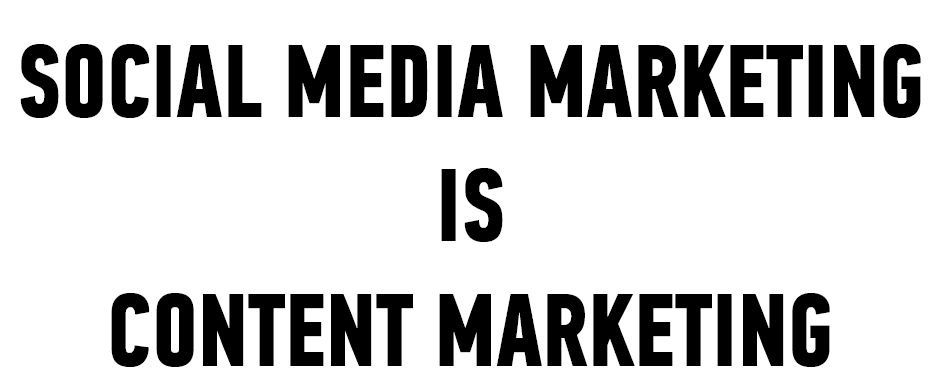
    We take this approach because social media marketing should be viewed as a subset of content marketing. Every word, image, video, graphic, photo, etc., is your content, whether you publish it on a blog or a long Instagram post. All your content should reflect your brand.

    Social media marketing is content marketing, and content marketing is an outgrowth and reflection of your brand in the form of educational, engaging, and exchange with your target audience.