Category: Digital & Content Marketing

Our blog on content marketing and digital marketing

  • Advanced Social Media Strategy @ GA Saturday 1-4PM

    This Saturday, I’ll be teaching a half-day class at General Assembly at Ponce City Market. This class is Advanced Social Media Strategies, which I’ve taught a few times before, and it’s always a fun class to teach. The class will be from 1-4PM, and here’s a high level look at what we’ll be covering.

    • UNDERSTANDING of what exactly social media marketing is. Hint: it’s content marketing.
    • STRATEGY always begins with your brand, and then your audience. Everything else is window dressing.
    • CHANNELS or which social media networks (e.g., Facebook, Pinterest, etc.) you utilize are governed by one thing, and one thing only. Hint: it’s not the channel that you are most comfortable with. There are best practices for every channel, but everything is still so new that experiments are highly recommended.
    • ENGAGEMENT is more than what you think, and you can have full on engagement without ever making a single post.
    • CALENDAR is your best friend and worst enemy, because nothing hurts like a date, but everyone loves a plan once it’s in place.
    • MEASUREMENT is your only means of seeing if you were right in any or all of your experiments.

    If you’re using social media to market your business, and you need to take your game to the next level, this is the class for you.

    And, yes, this is a complete and total shameless plug for the class I’m teaching. Also, it’s going to be dreadfully hot on Saturday afternoon, so take advantage of a beautiful morning in Atlanta, and then spend the afternoon in air conditioned comfort, learning how you can make a big difference on Monday.

  • How to Keep Telling Your Story

    Continuing with yesterday’s post, which gave five more reasons that every startup really needs to tell its story, it’s easy to understand how many startups simply don’t know where to start telling their stories. Many times I speak with entrepreneurs about blogging and they end up at a point at which they can’t see themselves having anything really good to blog about after they’ve covered the basics of their business. It’s a misnomer that once you’ve blogged on a topic, or created any content on that particular topic, you can’t focus on that topic again. It’s just not true. In fact, the opposite is the case.

    Ask any marketer how many times their target audience has to be shown the marketing message before they actually see it: at least 6, and more like 10. The same message has to be presented to your target audience 6 – 10 times before they ever realize what they’re seeing it. This is the same philosophy behind showing the same old commercials on TV over and over and over ad nauseam.

    Why should it be any different for your company’s blog? For many startups and most small businesses, the blog is the primary method of publishing the content of their marketing message. Here are three constructs that you can apply to your content calendar to make sure that you keep telling your story until your audience actually sees it.

    • Yesterday | Today | Tomorrow – This method is the simplest, and really is just what it says: what happened yesterday (or last week or month); what’s going on today (or this week or month); what’s planned for tomorrow (next week, month, or quarter). Literally, tell your audience what’s going on with your business. Have you hired anyone? Made any changes to your product or website? Gained any new partnerships? Created any new offerings? What’s coming in the future? What did you just launch or announce today?
    • Educate | Engage | Exchange – This model fits well into the types of content to offer up, assuming you have a lot of content as part of your business. “Educate” means to teach your audience something relevant to your business. Salesloft and Rivalry do a great job of teaching businesses different aspects of the B2B sales process. “Engage” is about engaging in a conversation on a more personal level by sharing your team, your culture, or your values. And “Exchange” means commerce, or a more direct marketing message, e.g., “Big Summer Blowout!”
    • Winter | Spring | Summer | Fall – This third construct is event and calendar driven, or may apply simply because your business is very seasonal, and you really do different things in each season. An example of this might be a restaurant with a seasonal menu or an outdoor patio or some other part of the restaurant that opens or closes depending on the season. 

    More than one of these constructs may apply to your business, and each requires a different level of planning using your content calendar. The idea is to make sure you never lack for content, types of content, and meaningful engagement with your audiences and customer segments.

    Which one of these content constructs might help you in telling your story?

  • Tell Your Story

    There are not many days that I don’t have the conversation with an entrepreneur or small business owner about “telling your story”. It’s incredibly important these days to maintain a constant flow of communications out from your HQ to your target audience. Here are 5 reasons that your outflow of story telling must stay constant and consistent.

    1. There is so much competition these days because it’s so easy to create a startup with a web site – a good looking web site – that it’s easy to be overrun in a space that you’ve owned, just because it looks like you’re asleep at the wheel and the new kid on the block is kicking it.
    2. The 24 hour news/social cycle enables someone who’s never heard of you yesterday to be your most adamant fan today, just because you connected with them and showed the right empathy for their pain.
    3. Your story is constantly changing because your are, after all, a startup, and that’s the job of a startup: do dozens of experiments until you find the right solution for the biggest problem with the most customers willing to pay.
    4. Your market is always growing, so there are always new customers who haven’t heard of you yet, and the most popular way consumers make decisions these days is by consuming real information from blogs and peers that they trust.
    5. Your audience is always looking for the solution to their problem. They just haven’t found you yet. Thirty years ago, would you have opened a little office and put out a shingle and then hid inside the office? No, of course not. You’d have set out to meet every potential customer in town so you could – wait for it – tell them your story.

    Now you have the internet. No more telling your story to one person at a time. Sangram Vajre, the CMO of Account Based Marketing startup Terminus, just published a post that somewhat transparently says “here’s the tools we use to market ourselves.” At the bottom of his mar-tech stack, the building blocks on which everything else relies, is, you guessed it, their blog. That’s how they tell their story. Check it out here.

    Those are just a few reasons that your startup needs to constantly tell its story. It just so happens that the easiest way to tell your story is in a daily, weekly, or bi-weekly blog. Tomorrow I’ll review a couple of constructs that can make it much easier to keep the stories flowing.

  • Nobody cares how much you know

    Two times with two different entrepreneurs today, we had to do a complete 180 as we evaluated their messages to their prospects. In both cases, the main part of the messaging was focused on what the startup does. “We provide this or that to these people for this price, etc.” But in both cases, delivering that message did not have the intended effect.

    In reworking the initial message for both of these entrepreneurs, I reminded them that they should start out by making sure their audience understands what’s broken. In other words, what’s the problem, and why should my audience care? How does this problem affect them?

    One of the entrepreneurs needed help understanding why you would begin a marketing message with a negative, with a problem. So I posed the following question to him. Which statement gets your attention, and makes you want to know more: a statement about how great your startup is, or a statement or question about a specific pain in your audience’s daily life?

    That’s when he got it. It made sense not to talk about “here’s what we do”, but rather about “you know how much of a pain it is for you to do this?!?”

    When you know your audience, and you have a deep understanding of the part of their daily life that’s broken, you have the ability to make that problem personal, to bring it home in language they can understand very easily. Then you have their attention to deliver your service message: “We solve that problem by doing this, that, and these so you don’t have to. Sign up to learn more.”

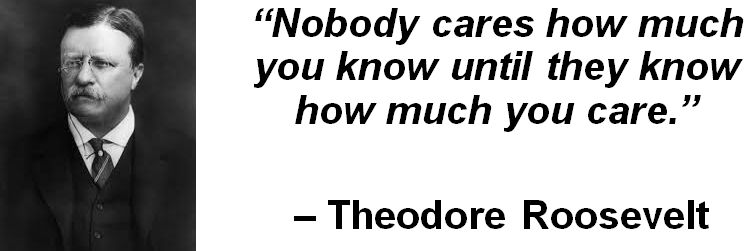
    Just like the Teddy Roosevelt quotation above, your audience couldn’t care less what you do until they know that you understand their problem, and can solve it. When creating your marketing message, remember to lead with the problem.

  • Digital Marketing 101

    A great shout out to the New York headquarters of General Assembly and their content marketing team. They host a great blog with tons of great content and contributors who really know their stuff. As one of the Digital Marketing instructors for GA Atlanta, I was asked to create a series of posts that sum up the 10-week DGM course (which we’ll be offering again in late summer / early fall), which we have called “Digital Marketing 101.”

    I really enjoyed creating this series, and it ultimately became the basis for the curriculum for the DGM Bootcamp that we conducted here in Atlanta on May 2. What a great class that was! We’ll be running that same all day bootcamp again on Saturday June 20.

    Below is a link to each post and a brief summary, so you can pick and choose which ones you want to dig into.

    • Developing your brand strategy – Everything starts with your brand. Your brand is everything you do. If you are not intentional about defining your brand, the market will define it for you. What are your core values? What is the problem you are solving? Who is your audience? What is your message, voice, and tone? All of these brand items and more must be addressed before the first tweet.
    • Measuring your Digital Marketing efforts – If you don’t measure it, you can’t manage it. Simple as that. So setup to measure everything, then set your 3-5 KPIs, and revisit them on a monthly basis, because they will change. Use Google Analytics, Twitter Analytics, Facebook Insights, and your email provider’s analytics tools, all of which are free and powerful to show you what works, what doesn’t, and who you’re reaching.
    • Owned content marketing – Every piece of content you have or create – blog posts, social posts, email newsletters, email signatures, video, audio, images, photos…everything – is your owned content. And all of it should reflect your brand, because your brand is everything you do. Social media marketing (unpaid) is included here, because a social post is a piece of content that you created, and is a reflection of your brand.
    • Social and search paid advertising – Google Adwords, Facebook Ads, Twitter Ads, Linkedin Ads, and (soon) Instagram promoted posts are all very affordable, very easy to engage in, and very powerful and hyper-targeted. Learn how to use each with precision and within your budget.
    • Understanding the Digital Marketing funnel – Starting with your total reach, we walk you down through your click through rate (CTR), conversion rate, sales cycle, items per purchase, price, average order amount, and revenue. You should setup and measure the entire funnel for every campaign and your aggregate efforts. Measure your ROI based on the results of the marketing funnel.
    • Creating your digital marketing calendar – Nothing hurts like a date, so using something as simple as a Google Spreadsheet, put a name, date, and status on every tactical effort: blog posts, social posts, videos, podcasts, etc. Knowing what you’re going to be publishing in 23 days eliminates the dreaded “what are we gonna post today!” syndrome, and frees you up to make plans to win like Arby’s and Oreo.
    • And a bonus: Digital Marketing Glossary – a simple, straightforward, easy to understand glossary of 40 digital marketing terms you need to know.

    So dig in, and learn digital marketing from scratch. It’s not that difficult when you have boundaries and a construct in which to begin. Thanks again to GA for letting me create these posts and the DGM Bootcamp. I hope to see you on June 20!

  • Teaching Twice at GA {Adult} Summer Camp

    General Assembly Atlanta is kicking off their {Adult} Summer Camp this week, and I’m honored and excited to be leading two classes during this fun week of digital learning.
    Wednesday evening from 7-9PM, I’ll be leading Pitch Camp. I just recently wrote about what we’ve learned from nearly 2 years and over 500 pitches at Pitch Practice every Friday, so this Wednesday evening we’ll be digging deep into each of these lessons. There are so many different aspects of pitching for your brand – corporate or personal – and we will spend a good amount of time working through various types and lengths of pitches. Everything from this 2 hour seminar is something you can immediately apply to your business, whatever stage you may be in.
    Thursday afternoon from 1-4PM is “How to Measure Social Media ROI“, which is the basis for this blog post. This seminar is a great class for those who are working in social media and need to gain a solid understanding of the costs of social media and how to attribute revenue to social media activities. With the advent and continuous improvement and focus on social selling, it’s very important to understand how social media plays in the marketing funnel, and that’s where we will be spending most of our time.
    I hope to see many of you on Wednesday night and Thursday afternoon for Pitch Camp and How to Measure Social Media ROI, along with some of the other classes that GA Atlanta has going on this week at Summer Camp.
  • Become a Digital Marketing Warrior Using the OODA Loop

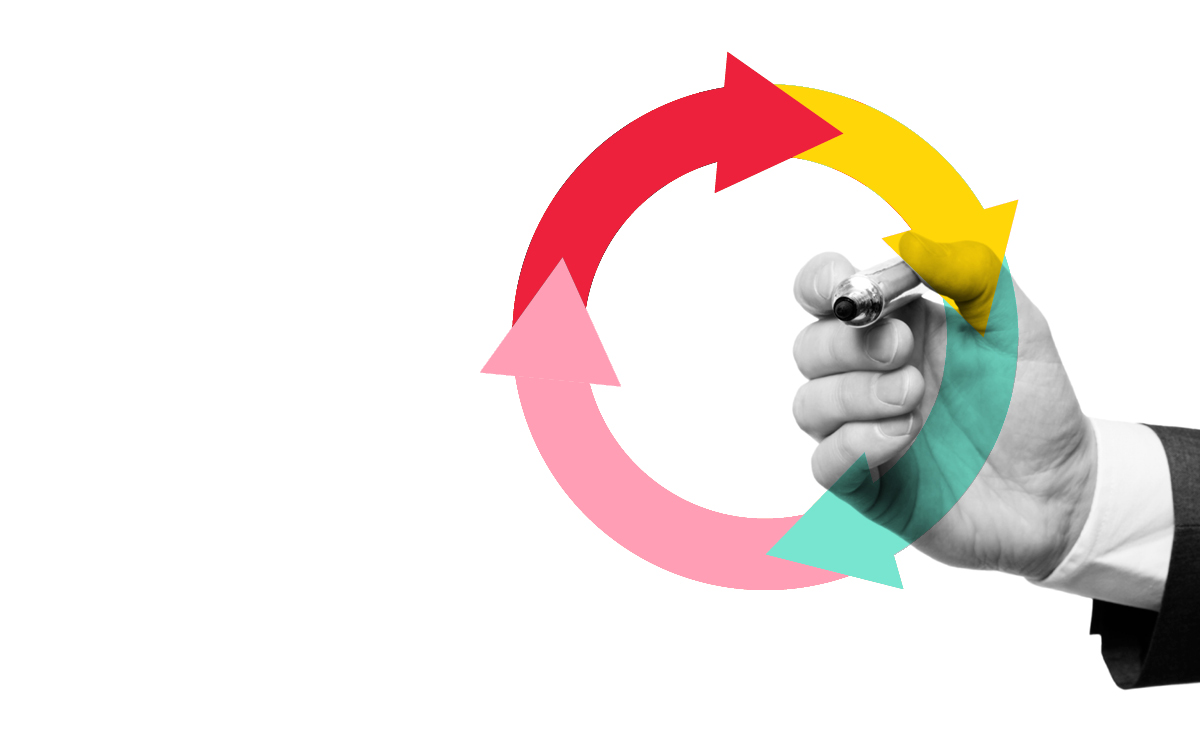
    The OODA loop was created as part of a military strategy developed by USAF Colonel John Boyd. Col. Boyd proposed that agility in any military situation involving humans would defeat raw power if the fighters continually used the OODA loop. We can do the same in our digital marketing efforts.

    The OODA loop applies to digital marketing because we are able to constantly experiment and get quick, accurate results using the digital analytics tools that we all have at our disposal. Here’s a simple walk-through of how one can create and implement the OODA loop into digital marketing efforts.
    1. Observe: what are your current assets in content, channels, reach; where are your customers; what types of content are they consuming; how are they acquiring products/services?
    2. Orient: how do your assets and abilities match up to the needs and location of your prospect/customer base?
    3. Decide: create an experiment with a definition of success and a clear measurement.
    4. Act: Conduct the experiment for a short time interval.
    Then you go back to the start. The OODA loop is a never-ending cycle of experimentation and optimization.
    Here’s a simplified example of how we use the OODA loop to learn.
    1. Observe: You have a video of your CMO delivering a presentation at an industry conference.
    2. Orient: She knocked the speech out of the park, but there were only 175 attendees at the conference, and your market audience is tens of thousands of C-Suite executives.
    3. Decide: You could easily share this video on YouTube, and promote the video in your next blog post and email newsletter.
    4. Act: You post the video on YouTube, and write a short blog post, which will also be used as text in the next newsletter.
    Now you begin again.
    1. Observe: Your audience loves the video, and the video gets more than 1000 views on Youtube; however, many people comment that there are some sections of the video that are not clear and that the audio was not perfect in a couple of spots.
    2. Orient: It’s about $1 per minute to get audio and video transcribed using a service like Speechpad, so getting the transcript of your CMO’s speech would be less than $20.
    3. Decide: Get the video transcribed, and turn the text into a series of blog posts.
    4. Act: Create a campaign based on your CMO’s speech, featuring the video supported by the corresponding blog posts.
    Remember, the OODA loop is a loop, meaning it never stops, and is repeated often. The beauty of digital marketing is the speed at which we can conduct experiments until we discover tactics that work really well and tactics that we should avoid. Having a construct like the OODA loop helps you work through those experiments in rapid succession.
  • Three Marketing Analytics Tools You Should Already Be Using

    If you’re reading this post, you are most likely in or preparing to get into digital marketing. In the world of digital marketing, it’s all about the numbers. We conduct experiments, and measure them against our goals using the metrics and analytics tools that are provided for us to use to learn and get better at our craft.
    There are many tools out there, some free and some paid, but the easiest tools to access, use, and learn from are completely free. These are analytics tools that you should be using today.

    Google Analytics
    Google Analytics is a free service available from Google, because Google wants us to know what’s happening on our web and mobile properties so we can see the impact of great marketing, and more importantly to them, great advertising buys. It’s relatively simple to begin using Google Analytics, especially if you are using the most popular blogging platforms. We’ve provided simple tutorials for how to setup your Google Analytics account, and how to connect Google Analytics to WordPress, Blogger, and Tumblr. Google Analytics is supported very well, and you can learn just about any task you need to complete on the Google Analytics Youtube channel.

    The very simplest data you will get from Google Analytics is an overview of who visited your web site, where they came from (both geographically and from what link), how long they spent on your site, and what pages they visited. It only gets better, deeper, and more thorough from there. If you are operating a web property, Google Analytics is the very first tool you should activate, learn, and use on a daily basis.

    Facebook Insights
    Facebook has 1.4 billion users, and while marketing a business on Facebook is constantly changing, there is no debating the power of reaching any fraction of 1.4 billion people globally. Once you setup your organization’s page and get to just 30 likes, you’ll have access to Facebook Insights, which is their analytics tool. If you’re marketing anywhere, you want to see the data to measure your effectiveness, and when you’re marketing on Facebook, they provide a great free tool for you to do just that.

    Insights lets you easily see your page’s overall performance (likes), learn which posts have the most engagement (clicks, likes, comments, and shares), and also see data about when your audience is on Facebook. From just these insights, you’ll instantly be more knowledgeable about how and when to post to get the most engagement on your page. In addition, you’ll be able to see, for each individual post, what the “reach” of that post is. Facebook’s organic reach – the number of people who naturally see your post in their timeline – has been the subject of much discussion lately, but you’ll be able to see for yourself exactly how many people saw and engaged with each of your posts.

    Twitter Analytics
    Twitter offers a similar, and just as free, tool for all users, which they call Twitter Analytics. There is no bar to reach in order to get access to Twitter Analytics. Any active user can instantly get access to all of Twitter’s analytics data.

    When you start using Twitter analytics, you’ll quickly realize that some tweets get lots of attention, and others just don’t. That’s why we digital marketers conduct lots of experiments, so that we will get to know what our audience tends to engage with and what our audience doesn’t care about.

    Twitter analytics gives you a full view into each and every tweet, as well as your overall performance, biggest follower, top tweet, top mention, and top media tweet. For your aggregate performance, you’ll see your total engagement rate, meaning what percentage of your followers and your followers’ followers saw your tweet and engaged by favoriting, retweeting, replying, or clicking on your link or your embedded media.

    Each of these analytics tools is crucial to your daily knowledge of how your tactical marketing efforts are performing. Attempting to engage in digital marketing without these tools and other analytics and measurements is like flying a really fast airplane with no instruments. You can guess where you are and how you’re doing, but you’ll never know for sure without the numbers.
  • Experienced Entrepreneurs Should Blog More

    Earlier today, Allen Nance tweeted his “new strategy” for engaging in social media:

    I replied to Allen, “you left out #blog: where you teach others.” Around the end of the day, I had a conversation with KP Reddy about his latest torrent of blog posts, which are pure no-BS, entrepreneurial gold.

    Turns out, KP and Charlie Paparelli have a little unspoken gamesmanship going on. KP had urged Charlie to begin regularly sharing his experiential wisdom, lessons, advice, and general “been there, done that” talks on paparelli.com. Charlie has done just that, and I, for one, cannot get enough of it. It’s real. It’s Charlie’s story, not just about startup-land and happy happy joy joy, but his battle with alcohol, successes, failures, and struggles.

    What if you could regularly soak up all the stuff they’ve seen, done, experienced, and been through…all the challenges they’ve faced, all the mountains they’ve climbed, all the obstacles they’ve overcome, and all the lessons they’ve learned through their journeys?

    You can. We can. It just takes a little encouragement. KP urged Charlie to blog. Charlie did, and then elbowed KP with a kind nudge that he should do the same. And, voila! You have two of Atlanta’s most successful, experienced, respected, and connected entrepreneurs sharing their wisdom. That’s how we learn. First by being willing to learn from others, and second by actively seeking out their wisdom.

    So, if you get a chance, thank Charlie and KP for sharing their wisdom, and ping Allen (and maybe Paul Judge, too!) and remind them that they have TONS to share and teach the Atlanta entrepreneurial community.

    Who else do you know who has untold sums of entrepreneurial and life wisdom? Encourage and challenge them to share that wisdom. It’s cathartic for them, and pure gold for the rest of us. 

    And to those who do regularly share their wisdom, thank you for doing so.

  • How to Measure Social Media ROI

    Using social media to market your business is something every business should do; however, despite what some may think, social media is not free. There’s at least a minimum investment that you have to make, even if it’s just your time, existing knowledge, and ability. When there’s an investment in the business, it becomes necessary to measure the return you’re getting on that investment, your ROI.
    But how do you measure the ROI of social media? Well, the math is the same as any other ROI calculation:
    ROI = (RETURN – INVESTMENT) / INVESTMENT
    The math, the calculation, is easy. Defining “return” and “investment” are the hard parts. Here are 7 variables to consider when measuring, proving, and defending the ROI on your social media investment.
    1. CONTENT IS KING
    What content will you be sharing via your social media channels? Kabbage, the largest online small business lender, recommends, “First and foremost, you should have a blog on your site where you create compelling content.” Buffer, the social media sharing software tool maker,
    Buffer, the social media sharing software tool maker, backed up Kabbage’s statement with this: “Ninety percent of our social media updates are based on content we’ve written on the blog.” OK, so you’ll need a blog, which will cost something – usually someone’s time – to set up, and then someone must create regular compelling content for that blog, either an employee, freelance writer, or an agency. Content is an investment.
    2. CHANNEL YOUR FOCUS
    What social media channels will you use to share this content? You may have to do some research to determine where your target audience is, and they may be on more than one social channel. The research to learn this fact will take someone’s time. There’s another investment.
    3. START WITH A GOAL
    Every organization has goals, and the goals for social media should flow from within the organization’s goals and brand. If you have goals, that means you’re doing this particular exercise for a reason, and that reason is not just “so we’ll be present on social media.” Your goals for social media should support the organization’s business goals, which are usually focused on revenue, costs, brand, and product. If you don’t have goals, then you really need to ask yourself why you are being paid to handle social media for your company. You are an investment.
    4. TRACK YOUR CAMPAIGNS
    If you don’t track it, you can’t measure it. If you don’t measure it, you cannot manage or change it, which is to say you cannot improve it. To track social media, by which I mean track how your social media followers are interacting with your content, you should use Google URL Builder and some form of URL shortener (goo.gl, bit.ly, ow.ly, etc., or a custom URL shortener). Google URL Builder enables you to use UTM parameters to perfectly and clearly identify exactly where the link was and why it was there when your audience clicked it and where your audience landed when they clicked on your URL. You’ll need to store these URLs in a simple spreadsheet or in your CRM for each campaign.
    5. MEASURE YOUR EFFORTS
    Each campaign should have its own ROI. Measuring involves tracking each campaign from conception to completion, from blog content to social media post to click through to lead generation to customer conversion to revenue. Each campaign should be tracked all the way through the marketing funnel or the AARRR processGoogle Analytics is free, but it will take time to learn and master, and it will cost you something – time, favors, or money – to get your website properly setup to track and measure every engagement in every campaign within Google Analytics. Tools likeBuffer enable you to automatically add campaign tracking to every post.
    6. ASSIGN VALUE
    Over time, you will be able to establish and assign a value to each social media interaction, such as a follower on Twitter. For example, if you have 1,000 followers, and you send out a tweet with a clear call to action (CTA), you will earn a certain amount of impressions organically for that tweet. Some percentage of your audience will click on your CTA. Some percentage who clicked on the CTA will become leads, and some leads will convert into sales. The math (from this example) is easy: the value of a follower is derived by dividing the revenue from a specific campaign by the number of followers. This is a simple example, but it works for establishing a basic value of one follower. In other words, that value is the most you should be willing to pay to earn one follower if you invest in a paid ad on Twitter to boost followers.
    7. DRIVE REVENUE
    Measure the revenue that can be attributed to leads generated by this specific campaign, which you tracked via your long UTM parameter URL that you built with the Google URL builder, which were then captured by your CRM, from which you can run a simple report that shows total conversions and revenue. This is your return and you should measure it for each individual campaign.
    8. UNDERSTAND YOUR COSTS
    Or “investment” since we’re talking “ROI”. You must know your costs, which include everything above (except revenue), and including “value” if you invested in any social media ads to boost fans and follower numbers. Be transparent in your organization about which costs you are including in your calculation, and make sure you get complete buy-in, so you’re not sandbagging but also not being too conservative in your numbers.
    Do you have all these things? Good! Now you’re ready to do that simple math:
    ROI = (RETURN – INVESTMENT) / INVESTMENT
    Warning: you should only calculate your ROI on social media investment if you want to get a larger budget for next year, because when done right, social media driven by compelling content will win.