Become a Digital Marketing Warrior Using the OODA Loop

The OODA loop was created as part of a military strategy developed by USAF Colonel John Boyd. Col. Boyd proposed that agility in any military situation involving humans would defeat raw power if the fighters continually used the OODA loop. We can do the same in our digital marketing efforts.

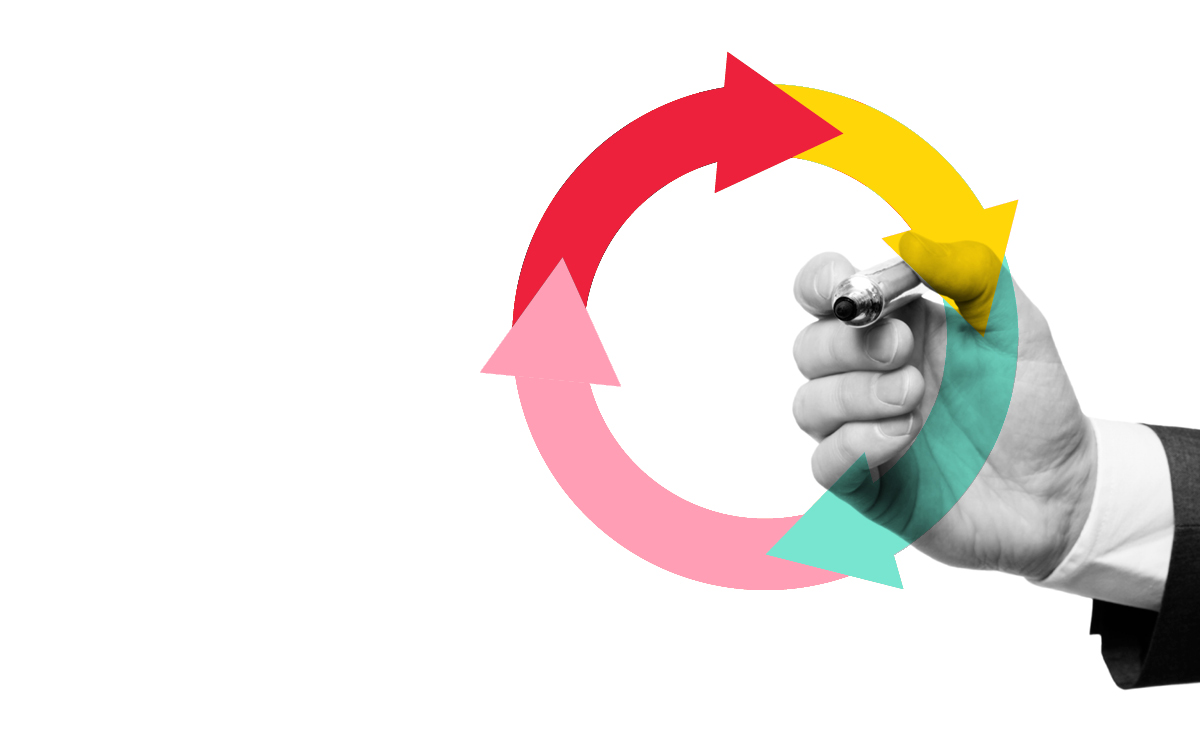
But first, what’s the OODA loop? OODA stands for Observe – Orient – Decide – Act. “Boyd developed the concept to explain how to direct one’s energies to defeat an adversary and survive. Boyd emphasized that “the loop” is actually a set of interacting loops that are to be kept in continuous operation during combat.
The OODA loop applies to digital marketing because we are able to constantly experiment and get quick, accurate results using the digital analytics tools that we all have at our disposal. Here’s a simple walk-through of how one can create and implement the OODA loop into digital marketing efforts.
1. Observe: what are your current assets in content, channels, reach; where are your customers; what types of content are they consuming; how are they acquiring products/services?
2. Orient: how do your assets and abilities match up to the needs and location of your prospect/customer base?
3. Decide: create an experiment with a definition of success and a clear measurement.
4. Act: Conduct the experiment for a short time interval.
Then you go back to the start. The OODA loop is a never-ending cycle of experimentation and optimization.
Here’s a simplified example of how we use the OODA loop to learn.
1. Observe: You have a video of your CMO delivering a presentation at an industry conference.
2. Orient: She knocked the speech out of the park, but there were only 175 attendees at the conference, and your market audience is tens of thousands of C-Suite executives.
3. Decide: You could easily share this video on YouTube, and promote the video in your next blog post and email newsletter.
4. Act: You post the video on YouTube, and write a short blog post, which will also be used as text in the next newsletter.
Now you begin again.
1. Observe: Your audience loves the video, and the video gets more than 1000 views on Youtube; however, many people comment that there are some sections of the video that are not clear and that the audio was not perfect in a couple of spots.
2. Orient: It’s about $1 per minute to get audio and video transcribed using a service like Speechpad, so getting the transcript of your CMO’s speech would be less than $20.
3. Decide: Get the video transcribed, and turn the text into a series of blog posts.
4. Act: Create a campaign based on your CMO’s speech, featuring the video supported by the corresponding blog posts.
Remember, the OODA loop is a loop, meaning it never stops, and is repeated often. The beauty of digital marketing is the speed at which we can conduct experiments until we discover tactics that work really well and tactics that we should avoid. Having a construct like the OODA loop helps you work through those experiments in rapid succession.

Comments

Leave a comment

More from Kevin

  • “Does SEO make anyone feel warm & fuzzy?”

    Lindsay Trinkle Visits #DGM2 Class @_GAAtlanta As we begin the second half of our 10 week Digital Marketing class, we welcome another great guest speaker from the Atlanta digital world. Our first speaker blew the doors off of market & customer segmentation, setting the bar high for our remaining three guest speakers. Tonight, Lindsay Trinkle,…

  • Three ways to auto-promote your blog posts via email

    Cross posted from the General Assembly Blog. There are many ways to share the content that you’ve created on your blog; however, the most reliable method of promoting your blog to your intended audience is through email. Most people check their social networks regularly, but everyone reads – or at least checks – their email…

  • The Math of the Marketing Funnel

    We’ve been talking about the marketing funnel just about every session of Digital Marketing, but we hadn’t really brought it to life yet. So, in our mid-term (10th session) of the #DGM2 class, we focused completely on the math of the marketing funnel. The marketing funnel, because marketing is ALL about the numbers. #dgm2 A…

  • Google Analytics for Bloggers

    We’re halfway through the Digital Marketing class here at General Assembly. One of the biggest challenges in the class is tackling Google Analytics, which is a big, hairy, complex beast of a tool that can either overwhelm you or totally guide you. If you are or aspire to be a digital marketer, then you must…

  • 10rocket’s Blog Challenge

    I’ve known Chris Turner, the founder of 10Rocket since early last year, when he and I met at Tech Talent South. Shortly after that, Chris enrolled in The Iron Yard‘s Ruby on Rails software developer course, because he wanted to be able to build the software product that he had envisioned. A few months later,…

  • Marketing is all about the numbers

    Tonight we got a special treat at our #DGM2 class: Maria Joyner of Synapp.io laid down the growth hacking truth on the class, setting the bar very high for our next three guest speakers. Who knew that Synapp.io was her first salaried job? The key to Maria’s success? “Find a startup that’s killing it, and…

  • On smartphones and social media

    Our kids (both 13) do not have smartphones. Yes, I know I’m a freak-parent for this day and age, but I’ll wear that one like a badge of honor. In a recent discussion about my and my wife’s horrible behavior, I was told by a friend as we discussed how much my children have “suffered”…

  • 7 Habits Of Highly Effective Bloggers

    Cross-posted from the General Assembly blog Beyond the obvious (write), there are tactics that you should build into the DNA of your blogging strategy. These are things that should become habitual, so you don’t even have to think about doing each of them. These are blogging habits that you see in the most successful blogs,…

  • Learn Something New

    I read a lot of blogs every day. A lot of blogs. Today, one of John Saddington’s four blog posts today (he blogs for himself and for Desk) caught my eye and made me think. John wrote about Roost, a plugin for WordPress that enables Safari users to get push notifications of new posts. So what?…