Become a Digital Marketing Warrior Using the OODA Loop

The OODA loop was created as part of a military strategy developed by USAF Colonel John Boyd. Col. Boyd proposed that agility in any military situation involving humans would defeat raw power if the fighters continually used the OODA loop. We can do the same in our digital marketing efforts.

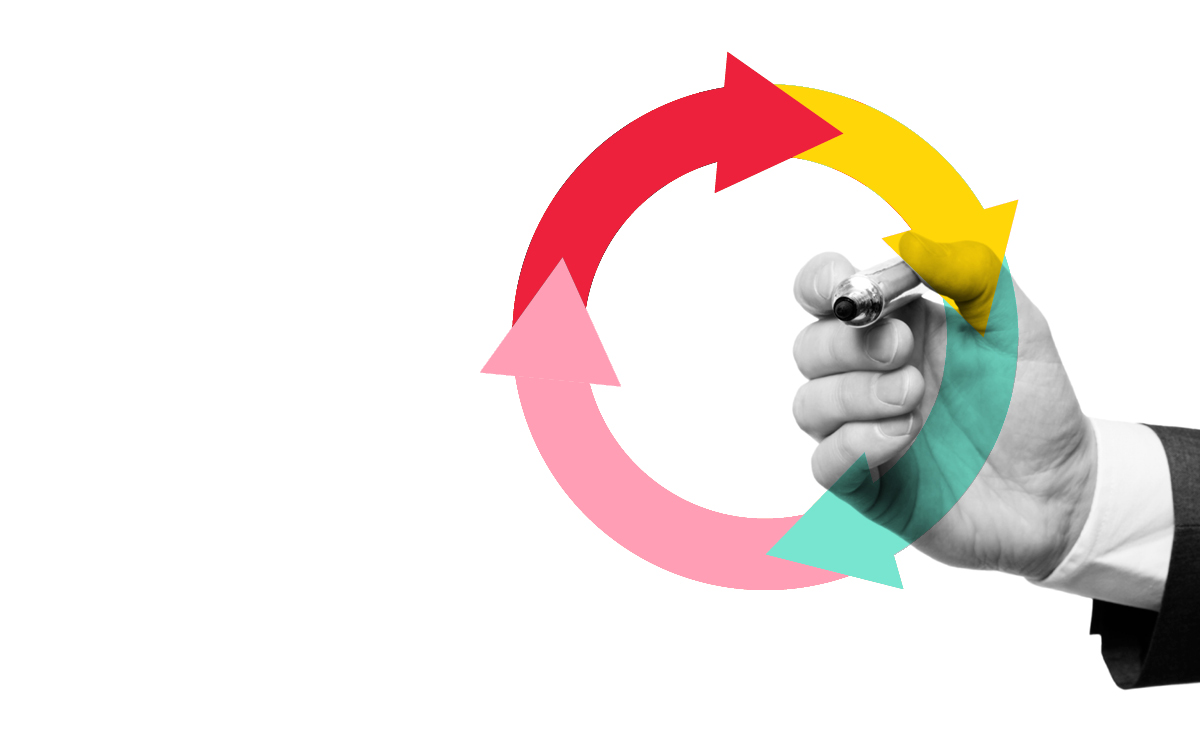
But first, what’s the OODA loop? OODA stands for Observe – Orient – Decide – Act. “Boyd developed the concept to explain how to direct one’s energies to defeat an adversary and survive. Boyd emphasized that “the loop” is actually a set of interacting loops that are to be kept in continuous operation during combat.
The OODA loop applies to digital marketing because we are able to constantly experiment and get quick, accurate results using the digital analytics tools that we all have at our disposal. Here’s a simple walk-through of how one can create and implement the OODA loop into digital marketing efforts.
1. Observe: what are your current assets in content, channels, reach; where are your customers; what types of content are they consuming; how are they acquiring products/services?
2. Orient: how do your assets and abilities match up to the needs and location of your prospect/customer base?
3. Decide: create an experiment with a definition of success and a clear measurement.
4. Act: Conduct the experiment for a short time interval.
Then you go back to the start. The OODA loop is a never-ending cycle of experimentation and optimization.
Here’s a simplified example of how we use the OODA loop to learn.
1. Observe: You have a video of your CMO delivering a presentation at an industry conference.
2. Orient: She knocked the speech out of the park, but there were only 175 attendees at the conference, and your market audience is tens of thousands of C-Suite executives.
3. Decide: You could easily share this video on YouTube, and promote the video in your next blog post and email newsletter.
4. Act: You post the video on YouTube, and write a short blog post, which will also be used as text in the next newsletter.
Now you begin again.
1. Observe: Your audience loves the video, and the video gets more than 1000 views on Youtube; however, many people comment that there are some sections of the video that are not clear and that the audio was not perfect in a couple of spots.
2. Orient: It’s about $1 per minute to get audio and video transcribed using a service like Speechpad, so getting the transcript of your CMO’s speech would be less than $20.
3. Decide: Get the video transcribed, and turn the text into a series of blog posts.
4. Act: Create a campaign based on your CMO’s speech, featuring the video supported by the corresponding blog posts.
Remember, the OODA loop is a loop, meaning it never stops, and is repeated often. The beauty of digital marketing is the speed at which we can conduct experiments until we discover tactics that work really well and tactics that we should avoid. Having a construct like the OODA loop helps you work through those experiments in rapid succession.

Comments

Leave a comment

More from Kevin

  • Three Marketing Analytics Tools You Should Already Be Using

    Cross-posted from the General Assembly Blog If you’re reading this post, you are most likely in or preparing to get into digital marketing. In the world of digital marketing, it’s all about the numbers. We conduct experiments, and measure them against our goals using the metrics and analytics tools that are provided for us to…

  • Experienced Entrepreneurs Should Blog More

    Earlier today, Allen Nance tweeted his “new strategy” for engaging in social media: New Strategy: @LinkedIN if I know you, @twitter if you can teach me something, @facebook don’t know, @instagram for surfing pictures. — Allen Nance (@AllenNance) May 26, 2015 I replied to Allen, “you left out #blog: where you teach others.” Around the…

  • How to Measure Social Media ROI

    Cross-posted from the General Assembly blog. Using social media to market your business is something every business should do; however, despite what some may think, social media is not free. There’s at least a minimum investment that you have to make, even if it’s just your time, existing knowledge, and ability. When there’s an investment…

  • What the Twitter + Google partnership means to the digital marketer

    Earlier today, my friend and fellow marketer Kevin Ekmark shared this story on Twitter about the renewal of the Twitter-Google partnership. From 2009-2011, Google had access to the Twitter “firehose” of data, but for reasons most of us won’t ever know, that partnership stopped. Then rumors of a rebuilding came about late last year. Now…

  • Take a Marketing Inventory

    General Assembly published my latest article on their blog today, How to Measure Social Media ROI. That post came from a seminar that we’re now teaching regularly at GA Atlanta, and is a great example of repurposing content from one media to many others. It’s not included in the blog post, but in the class,…

  • Science of SEO Debunked in One Word

    When I started Atlanta Tech Blogs as just a project to stay on top of the Atlanta tech startup scene, one of the concepts that kept popping up was “SEO“. I was familiar with SEO, but not in a guru kind of sense. I knew what it meant and I knew that if you want…

  • 5 Ways Instagram Is Different

    “I couldn’t tell where the lake ended and the shoreline began. It was just to beautiful.” Of course the 35 fresh catfish and venison poppers help. A photo posted by Kevin Sandlin (@kevinrsandlin) on May 9, 2015 at 4:21pm PDT I started using Instagram in late 2014 for the simple purpose of learning how it…

  • Knowledge vs. Understanding

    If you know about and already use the Google URL Builder tool, you can stop reading and move on to the next blog. If you’re still with me, wondering what the heck a URL builder is, then the next 3 minutes belong to you. One of the major components of digital marketing is measurement and…

  • What’s your zone?

    Yup, another Michael Jordan post. Way back in 1992, the Bulls played the TrailBlazers in the NBA Finals. In game 1 of the series, Jordan decided to start shooting three-pointers. He hit six threes in the first half, and ended up scoring 35 points just in the first half. After he hit number 6, he…